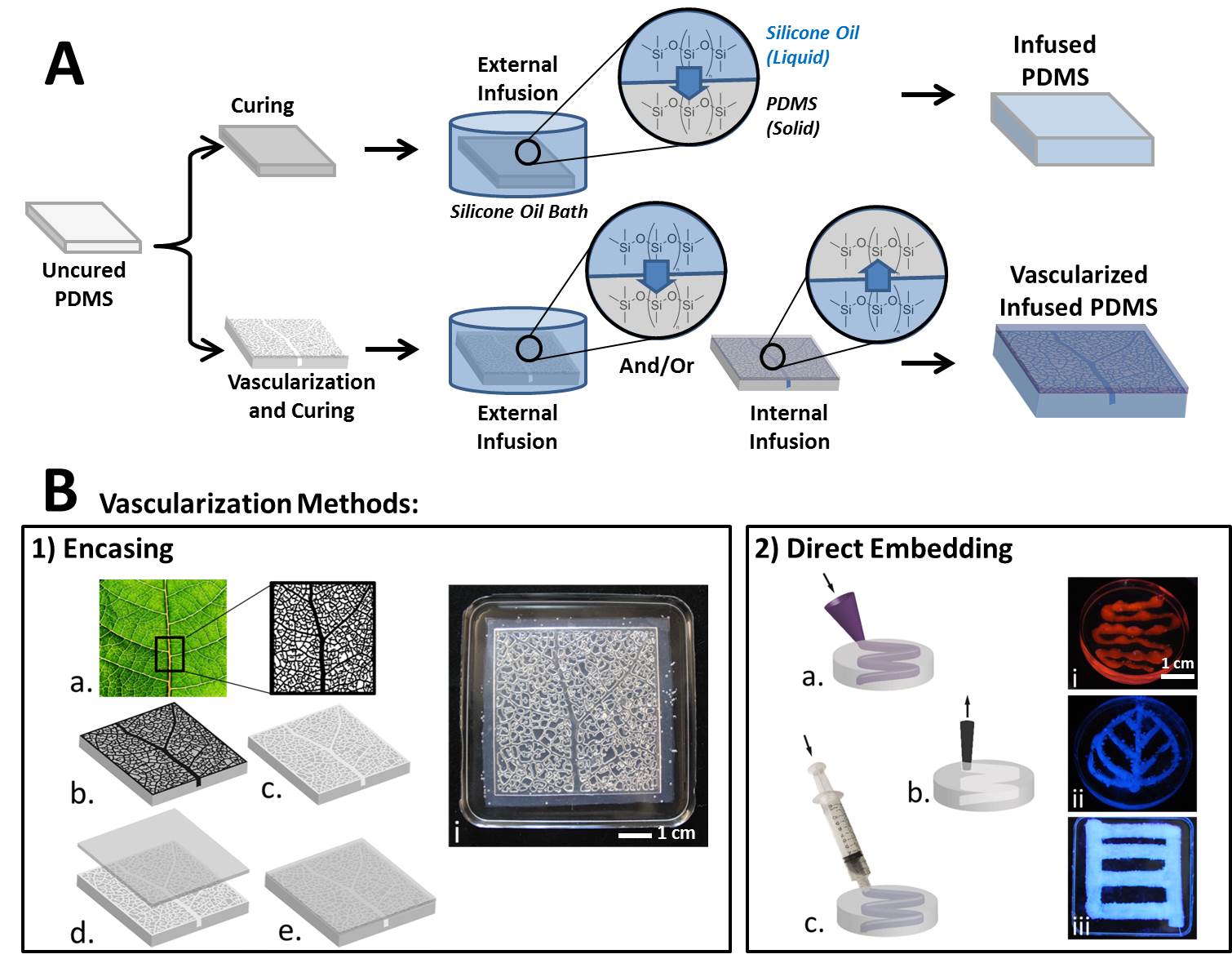
Fig. 3: (A) Schematic of the process to make either infused PDMS or vascularized, infused PDMS. For simple infused PDMS (upper row), cured PDMS is placed in a bath of silicone oil which diffuses into the PDMS solid. For vascularized PDMS, the vascular pattern is created before curing. The sample is then infused externally with silicone oil in the same manner as the non-vascularized PDMS, or internally through filling the vascular network, or both. (B) Methods of creating vascular networks within PDMS: 1) An encased network is created using a 3D mold (a) to create the pattern in PDMS (b). The mold is removed from the cured PMDS (c) and the pattern is covered with a second sheet of PDMS (d and e) which is chemically bonded to the pattern using plasma. (i) an image of a 3D leaf vasculature network after encasing. 2) An embedded network is created following the procedures developed by Lewis et al. (citation). (a) A pattern of 20% w/w pluronic F127 gel at 25 °C is embedded in uncured PDMS. (b) The PDMS is allowed to cure, cooled to 4 °C, and the liquid pluronic is evacuated. (c) The channel is refilled with silicone oil. (i) An image of fluorescently dyed PDMS in a hand-drawn sinuous channel, (ii) a hand-drawn leaf-shape network, and (iii) a 3D-printed linear network.