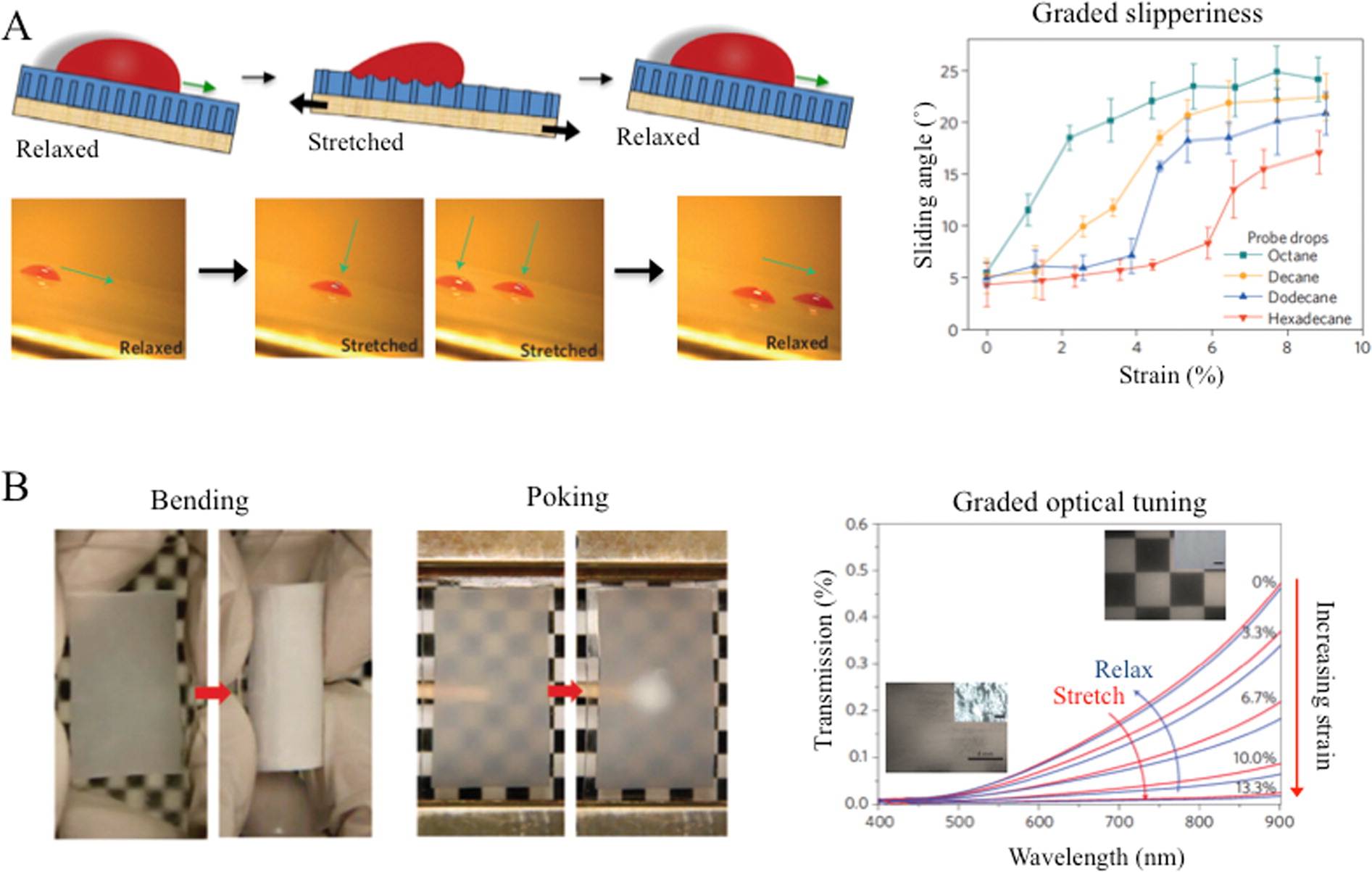
Fig. 2: Tunable droplet motion and optics. A. (Left) Stretching roughens the smooth liquid interface, stops a sliding droplet in its tracks, and pins a newly added droplet in place. Relaxing restores the smooth surface and allows both droplets to begin sliding. (Right) The surface slipperiness can be finely tuned by varying the degree of strain, with distinct response profiles for droplets with different interfacial tensions. B. Mechanical stress produces localized (left) and finely graded (right) reversible changes in optical transmission, with decreasing transmission directly correlated with increasing liquid roughness (right, insets).